Ultrafast Ultrasound based Flow Imaging
Most blood vessels run parallel to the skin surface, so the flow is transverse and conventional Doppler estimates are not reliable. We build beamforming and velocity estimation methods that recover the full velocity vector from non-steered plane waves, at frame rates fast enough to follow flow transients.
What This Project Sets Out To Do
Two objectives run through every result on this page: realistic flow models to test against, and beamforming that makes the velocity estimate worth trusting.
Flow phantoms generated in Field II with parabolic and gradient profiles at different velocities and flow directions, alongside in-vitro rotating disk and flow pump datasets acquired on a Verasonics scanner.
Non-linear high resolution beamforming, dual apodization at receive, and depth aware fusion, all built for non-steered plane wave transmit so the frame rate stays high.
Triangulation with autocorrelation and directional beamforming with cross correlation, compared head to head under the same acquisition so the beamformer is the only variable.
Validation against events, not just steady profiles: air bubble tracking, a sudden reversal of flow direction, and pulsatile flow in an in-vivo carotid artery.

Three Beamforming Approaches
Each approach targets a specific failure mode of conventional vector flow imaging. Figures are taken from the published papers listed below.
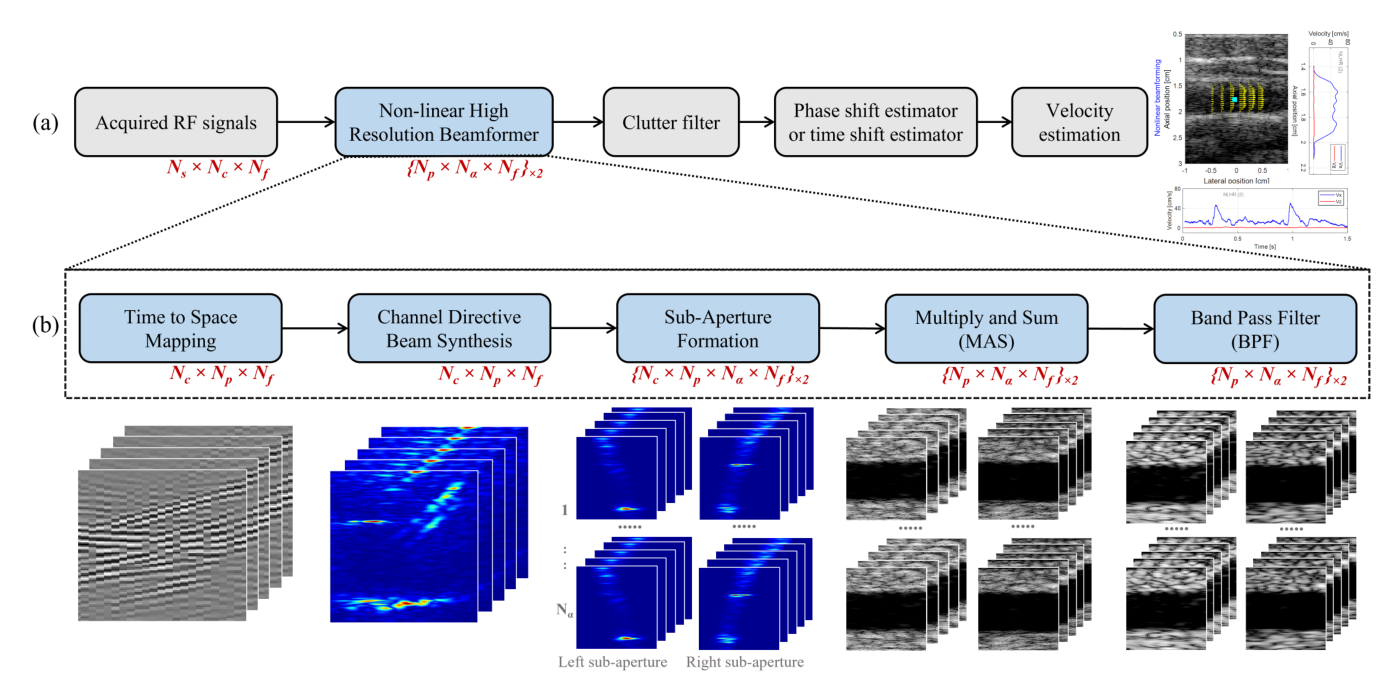
Non-linear High Resolution (NLHR) Beamforming
The conventional delay and sum beamformer is used almost everywhere in flow imaging because it is cheap, but it offers poor contrast, low imaging resolution and limited spatiotemporal sensitivity. Inspired by the F-DMAS beamforming in B-mode imaging, this work attempts to address the spatiotemporal sensitivity of the conventional flow imaging techniques with a novel non-linear beamforming approach, without the use of any contrast agents and deep learning based methods.
The gain comes from harmonic generation and enhanced coherence in the beamformed signals, which is what sharpens sensitivity to flow transients.
See the result videos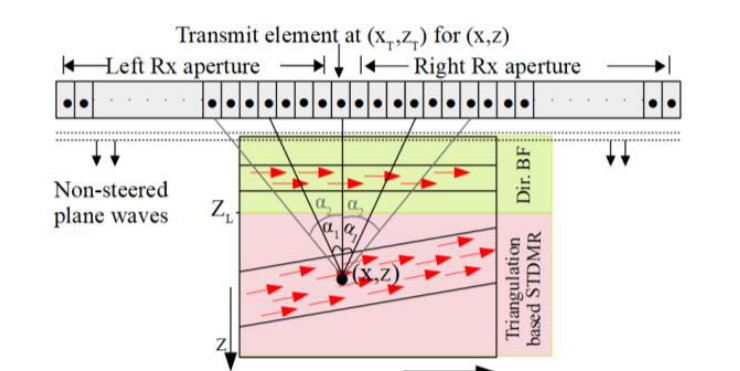
Angle Independent Depth Aware Fusion
In vector flow imaging systems, the most common beamforming techniques employed are the directional beamforming based cross correlation and the triangulation-based autocorrelation. However, the directional beamforming-based techniques require an additional angle estimator and are not reliable if the flow angle is not constant throughout the region of interest. On the other hand, estimates with triangulation-based techniques are prone to large bias and variance at low imaging depths due to limited angle for left and right apertures.
The hypothesis behind the proposed approach is that the peripheral flows are transverse in nature, where directional beamforming can be employed without the need of an angle estimator, and the deeper flows being non-transverse and directional, triangulation-based vector flow imaging can be employed. The switch is made at a limiting depth ZL set by the F-number and the receive aperture size: 15 mm in simulation, and 15.4 mm for the experimental study at an F-number of 1.71.
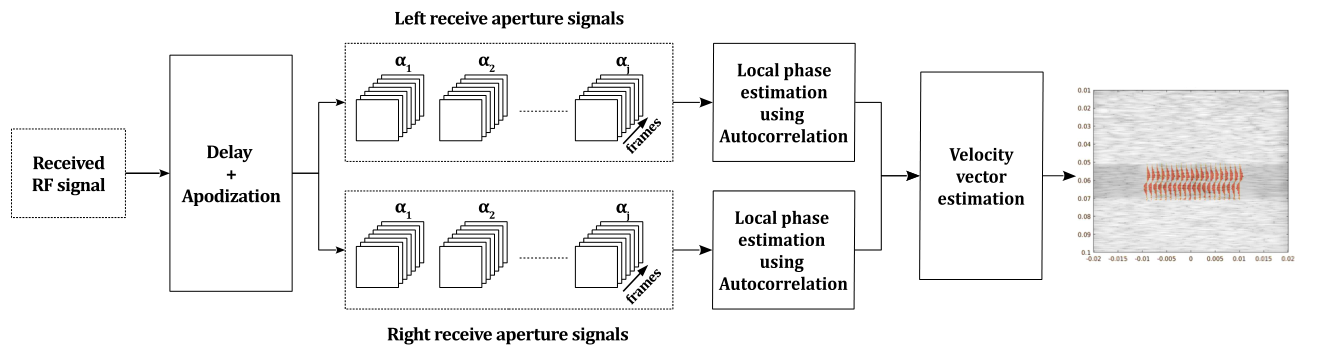
Non-steered Plane Waves and Dual Apodization
Most vector flow strategies steer plane waves electronically at several angles. Here the transmit stays non-steered and the angle diversity is recovered at receive. A triangulation algorithm makes a best fit out of the estimates obtained with different receive angles, which reduces the variability of the vector estimate with receive angle.
The dual apodization work takes this further, using multiple apodization to induce a steering effect at receive along with sidelobe suppression on the delay compensated RF signals. Simulations for transverse flows at different profiles and velocities show improved resolution and better clutter suppression.
In-vitro and In-vivo Results
Results shown here are reproduced from the papers. The in-vitro rotating disk dataset was acquired on a Verasonics scanner with a 128-element linear array under non-steered plane wave insonification at a 5 MHz centre frequency and a 10 kHz pulse repetition frequency.
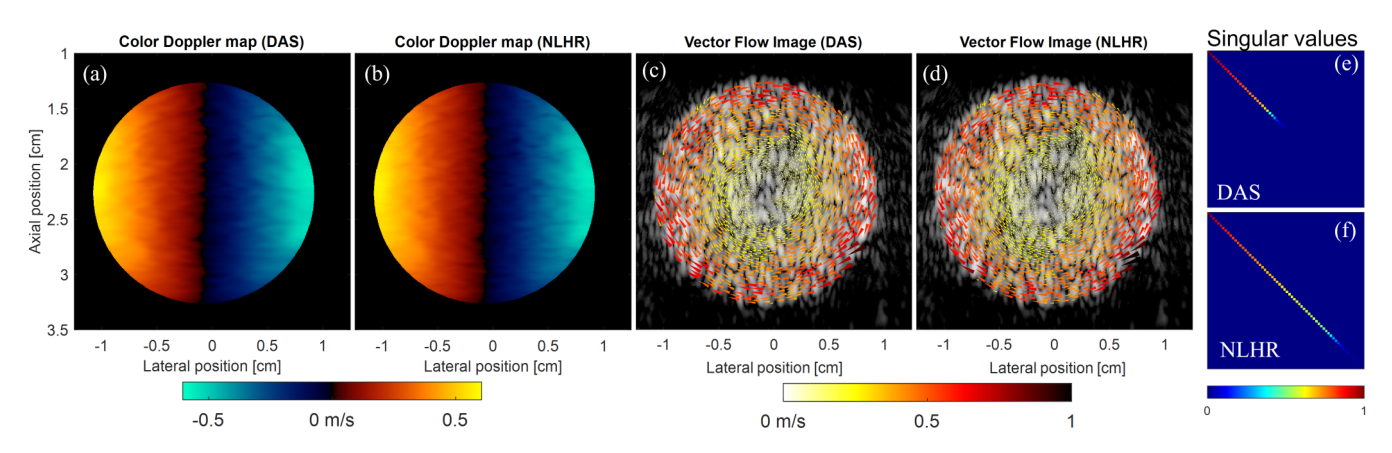
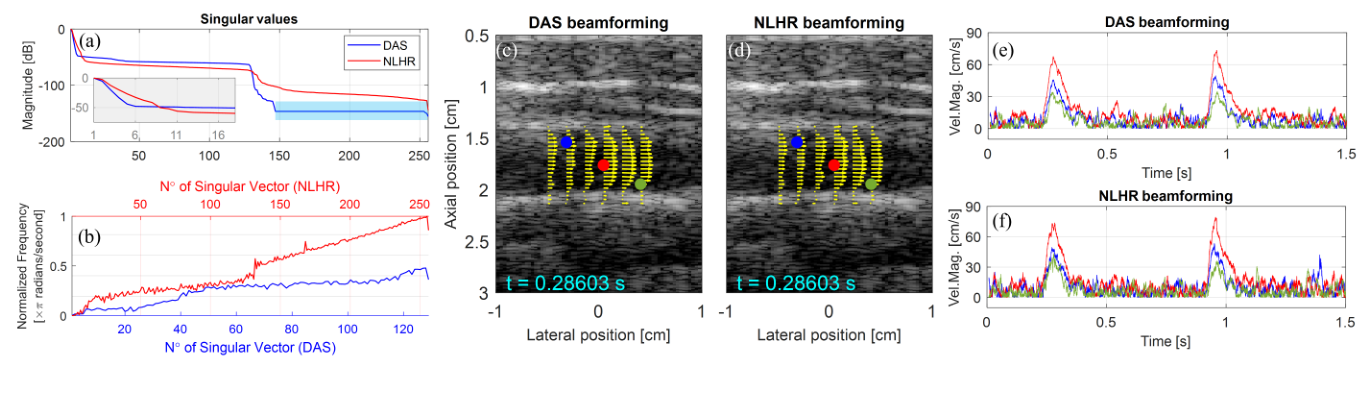
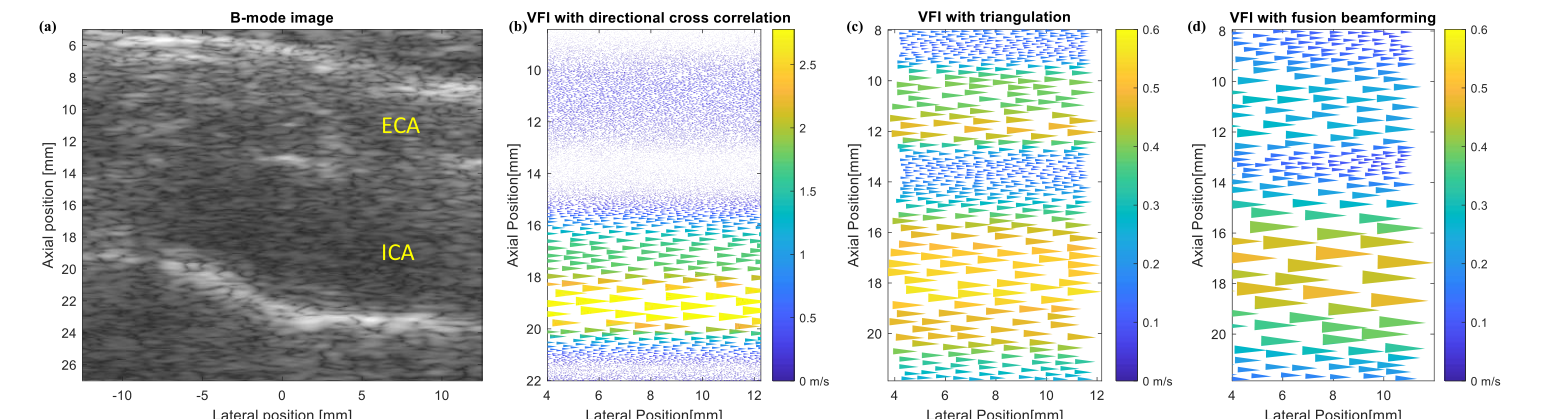


Still figures are cropped directly from the published papers. Detailed results for every test case in simulation, phantom and in-vivo studies are available as supplementary material with the journal article.
Result Videos
Eight video results for the non-linear beamforming test cases, from the NLHR Beamforming for Flow playlist.
Tracking of simulated pulsatile flows having five distinct impulses of different durationsSimulation
Tracking of simulated pulsatile flows having five impulses of different velocity changesSimulation
Non-linear Beamforming for In Vivo CarotidIn-vivo
Non-linear Beamforming for Air Bubble TrackingIn-vitro flow phantom
Non-linear beamforming results for flow Direction ReversalIn-vitro flow phantom
Non-linear beamforming for typical Pulsatile FlowIn-vitro flow phantom
Rotating Disk B-mode – DAS Vs Proposed NLHRIn-vitro rotating disk
Rotating Disk Color Doppler – DAS Vs Proposed NLHRIn-vitro rotating disk
Publications
Peer-reviewed work from this project. Citations verified against Crossref.